A Heritage Grain Moment: Farmer Mai and the Path to Our Table

Leave a comment
Uncategorized

I have some incredibly meaningful news to share with you — the kind that feels like a full-circle moment after years of slow, intentional work.

Through the generosity and connections of a few dear friends — Roe at Kings Roost, Nate from Fat Uncle Farms, and Katie from Mimsys_munchies Bakery — I now have in my hands a small but mighty harvest of heritage grain grown by someone extraordinary: Mai Nguyen, also known as Farmer Mai.

Who is Farmer Mai?

Mai Nguyen is a force. A farmer, seed keeper, policy advocate, and community organizer, she works at the intersection of ecological farming and social justice. Her mission? To farm in a way that undoes climate change and repairs systems of harm in agriculture.

Last year, she was awarded the prestigious James Beard Leadership Award for her work in celebrating sustainability, equity, and justice in food systems. Her impact stretches far beyond the field — she collaborates with communities and coalitions to create food policy that uplifts marginalized farmers and promotes land sovereignty.

In short: she’s a changemaker and a total badass.

Why This Grain Matters

The grain I received is Rouge de Bordeaux, a French heritage wheat known for its deep, layered flavor profile — think biscuit, roasted nuts, tannic apple skin, and a whisper of cinnamon. It’s beautiful, complex, and the kind of grain you feel in your bones when you bake with it.

This isn’t your everyday wheat. It’s part of a much larger story — one that begins with heirloom seed and ends at your table.

A Full Circle Process:

Here’s what the life of this grain looks like:

  • Heirloom seeds are planted using low tillage methods that preserve the soil.
  • Fields are cared for with natural pest managementintercropping, and crop rotation.
  • It’s dry farmednaturally dried, and carbon-sequestering.
  • Once harvested, it’s delivered directly to micro-bakers like me.
  • It’s freshly milled the same day the dough is made.
  • Then it’s baked and offered to you, in the most honest form possible.

This is what regenerative agriculture looks like — a cycle of care, intention, and respect for people, land, and the future.

The Bigger Picture

It’s taken me over four years to build relationships with farmers, millers, and advocates who share these values. And it’s not just about access to better ingredients — it’s about participating in a food system that’s accountabletransparent, and nourishing in every sense of the word.

This bakery exists to do more than bake. It’s here to be part of a movement — one that prioritizes organic practicesequity, and community-first sourcing. I feel deeply honored to now be part of this grain’s journey and to share it with Monrovia and surrounding communities.

Thank You, Farmer Mai

To Farmer Mai: thank you for doing the hard, necessary work — for farming in ways that restore the land and uplift those without agency in our current food system. Thank you for your radical care and your unwavering commitment to change.

To those reading: I can’t wait for you to taste the difference in what we bake together.

This grain — this moment — is something truly special.

For more information about Farmer Mai visit her website at farmermai.com
Recipe Use & Adaptation Guide for Cottage Bakers

comment 1
Uncategorized

Can you sell food made from someone else’s recipe found online or in a cookbook?

As a self-taught cottage baker these are important ethical questions I had to ask myself. I cannot create recipes out of thin air. I certainly didn’t learn sourdough on my own. I absolutely learned from cookbooks and online. After reading the Tartine cookbook, I settled on that as the primary way I approach baking. I may have increased my wheat percentage and hydration level but it’s fundamentally Tartine’s recipe and method. Is it okay to sell sourdough based on this cookbook? The short answer is, Yes. You are selling a product not intellectual property. The actual process of cooking and baking is not protected by copyright. In contrast, it is not okay to copy-paste that recipe and sell the recipe as your own. The latest influencer move is to sell recipes. It isn’t good practice or ethical to sell someone else’s work even if there is no regulating body that will hold you accountable for it.

What guidelines should we follow to adapt a recipe in order to call it our own?

As a self-taught baker, I always start with a base recipe. No one’s reinventing the wheel here-just giving it a fresh spin. If you are selling a recipe, how many things do you need to change to comfortably say it’s your own? The general rule of thumb is 3-4 meaningful changes should be made. It isn’t as simple as adding cinnamon to banana bread and claiming it as yours. If you swap the oil, add brown butter and tahini and top with sesame now it’s yours. When I adapt a recipe I often change a portion of the total flour from all purpose to a whole wheat Sonora. I will incorporate freshly milled flour to improve the freshness. I love adding obscure spices that aren’t normally found in dessert like urfa pepper and coriander. I like to change the fat used from butter to coconut oil. I will often change the sweetener from sugar to honey or date syrup. Lastly, I love to incorporate crunch with nuts and seeds. However, I am not as comfortable changing rising time, mixing methods or baking temperatures because that is the foundation or base. In the culinary world, especially among self-taught bakers, adapting and evolving recipes is not just common, it’s how recipes live and grow. Very few recipes are truly original in the strictest sense; rather, they are reinterpretations inspired by your personal taste. Baking is a science we need a reference point. One of the best parts of baking is being inspired and taking that inspiration to evolve a recipe by adding and subtracting and shaping it into something new. It is good practice to say “this recipe was adapted and inspired by.” This is not mandatory but creates a honest framework between you and your audience.

Best practices for Cottage Bakers & Influencers:

Adapt the recipe with intention.

Always credit your source when you’re inspired to gain trust.

Don’t sell or share complete recipes that you didn’t create.

If you’re teaching or sharing a recipe, ensure it represents your own work.

How to Maintain Focus and Balance in Business

Leave a comment
Uncategorized

I get asked all the time how I avoid burnout. The honest answer? I’m still figuring it out.

As a small business owner/micro-baker, we are multi-hyphenate—baker, recipe developer, bookkeeper, delivery driver, social media manager, customer service rep, cleaner. I also receive 30 to 50 messages a day—texts, emails, DMs. I’ve always taken pride in making people feel heard and answering each question thoughtfully and in a timely manner. But lately, I’ve noticed that constant communication is starting to chip away at my focus. I get distracted easily. Each time I shift gears to respond, it takes a toll on my productivity, my rhythm, and my body.

When my day runs long, I feel it the next day. My body is sore and my energy is low. And on top of all that, my people—my family—need me. They notice when I’m half-present (phone in hand). My husband side-eyes me when I reach for my phone when I finally sit down to catch up on our show. My kids love when my phone isn’t on the dinner table. My friends deserve my full attention when we’re together. But the truth is, it’s a tough juggling act: trying to be a present wife, mother, daughter, friend and a responsive, reliable business owner.

What I’ve come to realize is that protecting my peace and focus isn’t a luxury—it’s a necessity. I’ve started to make small changes that are already helping. During working hours, I turn on my phone’s “Work Focus” mode. Emergency calls can still get through, but everything else—texts, notifications, pings—waits until I have the space to answer. And when I do respond, I can give a thoughtful answer not rushed. I no longer apologize for not replying immediately. I can’t keep up with everything instantly, and that’s okay. Every message matters to me—but I’ve learned I have to protect my time and energy in order to keep doing this type of work.

Burnout doesn’t come from hating the work. I love this work. I feel grateful to do it every day. But that doesn’t mean it doesn’t tire me out. Long days, early mornings, late nights, and “off days” that are still filled with shopping, cleaning, recipe development and testing, menu planning—it adds up. And rest? That can feel indulgent. Even selfish. But it’s not. I need the energy to be a wife, mother, daughter, sister and friend. I also need the energy to be the kind of baker and the kind of person I want to be. Burnout comes from the inability to separate yourself from work.

If you’re reading this and feeling overwhelmed, I hope you know you’re not alone. You’re not weak or broken. You’re just carrying too much, for too long. If you need permission to put it down for a little while—here it is. You deserve time to recharge. Your business won’t fall apart. In fact, it will be stronger when you return to it rested, clear-headed, and full-hearted. I am learning how to give myself grace too.

The small business conundrum

Leave a comment
Uncategorized

When I started this business three and a half years ago, I was very wide-eyed and inspired to bring my community the highest quality sourdough and desserts money can buy. I pride myself on using as many organic ingredients as possible, even down to the sugar. As this small business started to grow, my costs started to grow as well. The upfront costs took almost two years to pay off: mixer, fermentation refrigerator, Simply Bread Oven, bannetons, bread tins, and so on. Going into the third year, I hoped that I was finally going to be out of the red and into profit. In the third year, I saw exponential growth due to my time at the farmers’ market. As my baking quadrupled, so did the cost to bake at that level.

If you ever wanted to know what it costs to operate at this level. I am about to be very frank so buckle up because it’s going to feel surprising. It may even help you appreciate the vendors at your next farmers market.

To be at one farmers market, including my event permit that allows you to sample food (costs more) and the daily rate costs $354 a month. If I can’t make a farmers market, I still pay to be there to secure my spot. If I choose not to pay when absent, they can place me in an undesirable location upon my return.

Hiring help was the next cost. On average I bake, label, and package 246 items. I am a scratch sourdough baker, which translates into long hours. Going into this fall season, I will double that number. I was killing myself being a one-woman show. I mean, I loved it so much, but it was definitely not sustainable. I brought on my Mom who was willing to help for free. However, everyone deserves to be paid for their time. This summer, I trained two lovely young ladies to help as backup. On any given day, I have one or two employees helping me get all the items baked, cooled, labeled, packaged, and out the door.

Inflation is the other factor making my profit margins razor thin. I haven’t raised my prices since I started three years ago. This year, we are finally seeing inflation come down a bit. Nonetheless, the price of food, gas, and housing has remained high. On average from 2020 to the present, food costs have increased 24.6%. The price of electricity in California has gone up 39% from 2020 to 2023, with plans to increase another 11% in the next year. In the city of Monrovia, our personal water bill has seen an increase to around 30%.

When I use my Square app or Venmo app to charge items at the farmers’ market, there is a 3% fee that I absorb. This does not include the costs I need to operate, including permits, required insurance, health inspections, website fees, and licenses.

The average cost for an artisan country loaf nationally is $12. This does not mean that it is organic, freshly milled local heritage grains. It could be the low-cost mass-produced glyphosate commodity flour that is stripped of important minerals and nutrition. This flour can contain additives to improve the flour’s shelf life and baking performance. Artisan flour is made by millers who work closely with farmers and pay fair prices for their grain. Wildflour works with local farmers and purchases the most expensive non-GMO heritage grain money can buy. The price difference is 3 to 1. Commodity flour: $1 per pound or less. Heritage grain: $3 per pound. The next time you see sourdough at the farmer’s market, question the quality. They may be your local baker, but do they buy locally? Do they pay attention to the quality of ingredients? Is there transparency? Wildflour Artisan Sourdough is organic-freshly milled heritage grains that is long cold fermented for optimal flavor and digestibility. It is important to know what you are paying for.

As a small business owner, I am now faced with a decision. Do I find a way to cut costs via cheaper, lower-quality ingredients when I cannot change the variables discussed above? Do I raise my prices to keep the quality, knowing I may lose some customers? For me, there is only one answer: raise my prices and hope that my customers trust that I am doing my best to keep things affordable while balancing quality. I take so much pride in being our community’s sourdough baker. I am not interested in being too expensive for the community. I have held out as long as I can to give you something amazing and affordable. I care about my community and hope you understand. I know times are tough right now. Just know that I am in the same boat as you.

All inflation statistics found on Google AI Overview.

Cook to Baker

comments 2
Uncategorized

So much has changed since my last Karen’s Kitchen-recipes for the home-cook blog entry. We were still in the thick of the pandemic and my life was pivoting from the home-cook who shared her tried and true recipes to becoming a sourdough baker. My last entry was about working my way through the Tartine cookbook and sharing my journey with you. Life had different plans for me. Instead, of making every recipe from a cookbook. I started a small business from my home. I became a cottage food operator and slowly built a micro-bakery out of my home kitchen.

I was always an intuitive cook. I loved to improvise and measure ingredients with my heart. Baking always seemed to rigid and kind of boring to me. During the pandemic with more time on my hands, I decided to explore sourdough. Sourdough didn’t seem like baking in the traditional dessert sense. It was bread, not sweet at all just flour, water and salt. Somehow, it felt closer to cooking to me. I learned I would need a scale, food thermometer, lame to score the bread and lastly a sourdough culture. I made my own flour culture, and went to the university of Youtube and Instagram to learn and figure out everything. At first, I was really intimidated by the scale and measuring in grams. So many new terms to try and figure out like autolyse and levain. It’s was definitely like stepping into a whole new world of cooking.

I made my first sourdough boule on April 27th, 2020. I have been addicted ever since. I bought the Tartine cookbook and it really streamlined the way I bake now. If you bake sourdough you know that you can never bake just one. I always made two, one for home and the other for my work family. My work family really enjoyed the homemade bread. Some of them began asking if they could pay for a loaf to keep for themselves. At first, I resisted payment but then money was literally being placed into my pockets. That’s how Wildflour Artisan Sourdough was born.

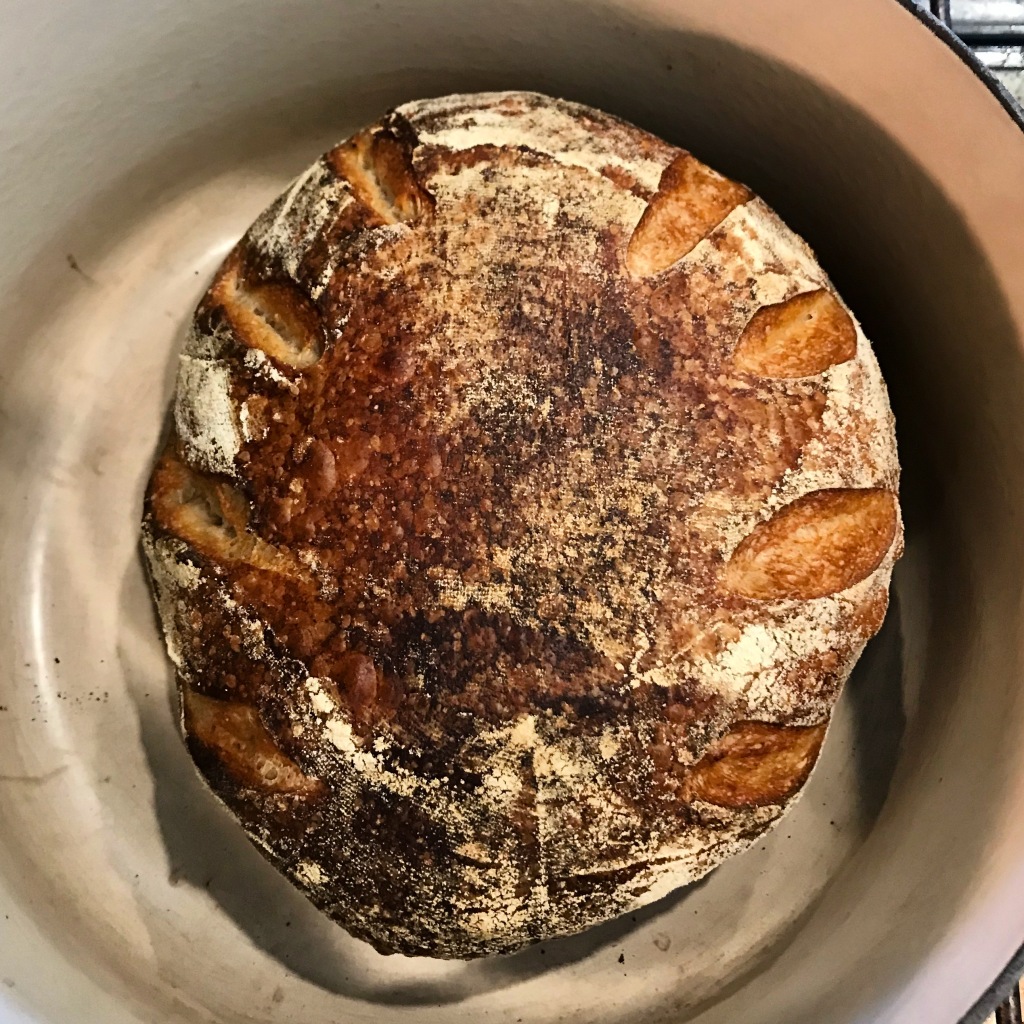
My first loaf

My first loaf

In hindsight, my first loaf was not great but at the time it was the best loaf I had ever tasted. I really fell in love with the process. I knew it was something I wanted to be good at. I will always chase the perfect loaf. I have cooked/baked so many things in my life but nothing is as satisfying as homemade bread.

I am no longer Karen’s Kitchen. I had to change the name of my blog so that I can share with you all things related to the world of sourdough and small business. I want to discuss the politics, environmental and social impacts of our grain economy. Specifically, regenerative farming and preservation of heritage grains. I want to explore the health benefits behind sourdough. I want to share with you the trials and tribulations associated with a micro-bakery. This will be written in a very informal way. Almost like diary entries. Things on my mind that might also interest you. I am looking forward to pouring my heart out again. Cooking/baking are definitely my love language. Sometimes I rather let the food do the talking. If only you could taste what I write about. Until the next time my friends. Happy Baking!